
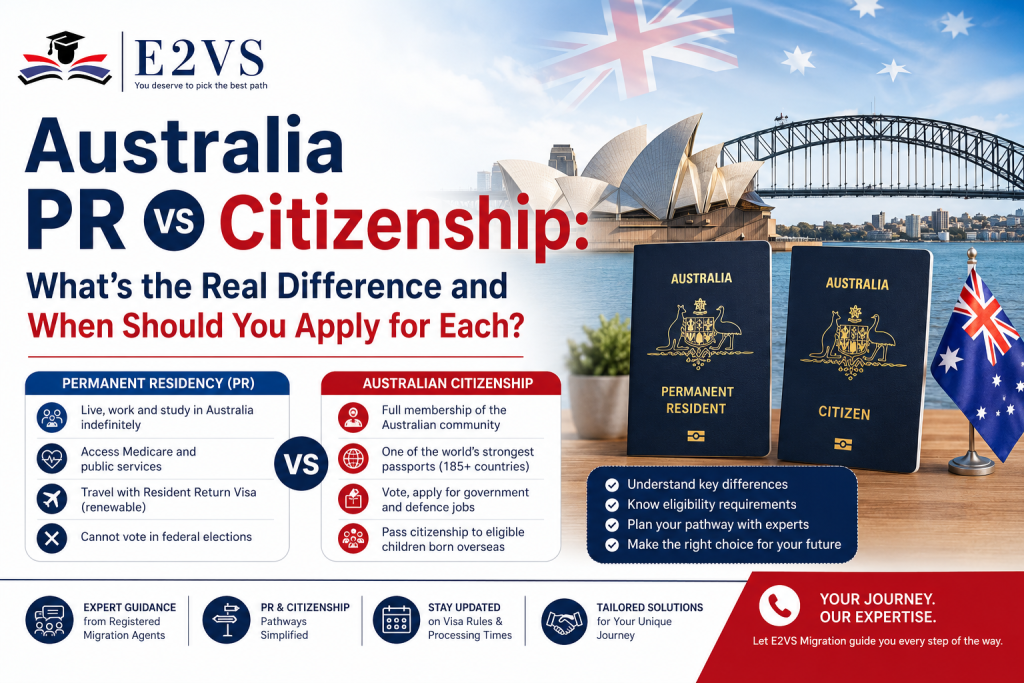
As you consider making Australia your permanent home, there will be a point when you have to make a decision, you will either go for Permanent Residency (PR) or you will get Citizenship. One of the most common questions asked at E2VS Migration is: Which option is right for me? This will be based on your stage in the migration journey.
What is Australian Permanent Residency (PR)?
The first step to long-term settlement in Australia is to obtain a visa to live in Australia. It allows you to live, work and study in Australia indefinitely, but it doesn’t make you an Australian citizen.
As a PR holder, you can access Medicare, sponsor eligible family members and access public services, such as NDIS. Your PR visa also has a travel facility for five years. Once the travel facility expires, you may need to apply for a Resident Return Visa (RRV) to re-enter Australia.
The most popular PR pathways are visas under the Subclass 189 (Skilled Independent Visa), Subclass 190 (Skilled Nominated Visa), Subclass 491 (Skilled Work Regional Visa), Subclass 191 (Permanent Residence Skilled Regional Visa), and the subclass 186 visa (Employer Nomination Scheme Visa).
What Is Australian Citizenship?
Citizenship is the final step in the migration pathway and represents full membership of the Australian community. It offers greater security than PR because it is permanent and does not require renewal.
Australian citizens hold one of the world’s strongest passports, offering visa-free or visa-on-arrival access to more than 185 countries. Citizens can vote, hold government and defence positions, access overseas consular assistance, and pass citizenship to eligible children born overseas.
Key Differences Between Australian PR and Australian Citizenship
1. Living and Working in Australia
Both Permanent Residents and Australian citizens can live, work and study in Australia without restrictions.
2. Access to Medicare
Both PR holders and citizens are eligible for Australia’s public healthcare system, Medicare.
3. Travel Rights
PR holders need a valid travel facility or Resident Return Visa (RRV) to re-enter Australia after the travel facility expires. Australian citizens do not need to renew their citizenship status or travel rights.
4. Voting Rights
Australian citizens can vote in federal, state, and local elections. PR holders cannot vote in federal elections.
5. Government and Defence Jobs
Many Australian government and defence positions require citizenship due to security clearance requirements. PR holders may not be eligible for these roles.
6. Status Validity
PR status is permanent, but travel facilities require renewal. Australian citizenship is permanent and does not expire.
7. Citizenship for Children Born Overseas
Australian citizens can often pass citizenship to eligible children born outside Australia. PR holders do not have this benefit.
When Should You Apply for PR?
Many migrants first qualify through skilled migration, employer sponsorship, or regional visa pathways before obtaining PR. PR is an ideal option for individuals who want to live, work, and study in Australia immediately while building a pathway toward citizenship.
The foundation of Australian citizenship is permanent residency. Most migrants hold PR status for a period before becoming eligible for citizenship.
Before applying, it is also important to stay informed about the Australia visa processing time 2026, as processing timelines may vary depending on visa type, application demand, and government policies.
When Should You Apply for Citizenship?
Generally, applicants can apply for citizenship after meeting Australia’s residency requirements, including lawful residence and a period as a permanent resident.
Citizenship may be the right choice if:
- You travel frequently and want to avoid renewing RRVs.
- You wish to vote in Australian elections.
- You plan to work in government or defence sectors.
- You want greater long-term security and stability.
- You want the ability to pass citizenship to eligible children born overseas.
Common Misconceptions
Many people believe they can skip PR and directly apply for citizenship upon arrival. In reality, most applicants must first obtain PR and satisfy residency requirements before becoming eligible for citizenship.
Another misconception is that PR offers the same level of security as citizenship. While PR provides significant rights and benefits, travel facilities must be renewed, and PR status can be affected under certain circumstances.
Many migrants also worry that obtaining Australian citizenship means losing their original nationality. Australia generally allows dual citizenship, although applicants should verify whether their home country permits dual citizenship.
The E2VS Migration Perspective
At E2VS Migration, we understand that every migration journey is unique. The right pathway depends on your visa subclass, time spent in Australia, travel history, family circumstances, and career goals.
Most clients progress through the following stages:
Temporary Visa → Permanent Residency → Australian Citizenship
Each stage has its own eligibility requirements and strategic considerations. Delays or mistakes can affect both processing times and long-term outcomes.
Whether you’re preparing your PR application or planning your citizenship journey, our registered migration agents can provide professional guidance to make the process simpler, more accurate, and less stressful.
FAQs
1. Can I become an Australian citizen without first obtaining Permanent Residency?
No. In most cases, applicants must first obtain Permanent Residency and meet residency requirements before becoming eligible for Australian citizenship.
2. How long do I need to live in Australia before applying for citizenship?
Generally, you must have lived lawfully in Australia for at least four years, including at least 12 months as a permanent resident immediately before applying.
3. Does Australian Permanent Residency expire?
PR status itself is permanent, but the travel facility attached to the visa typically expires after five years and may require renewal through a Resident Return Visa.
4. What are the benefits of Australian citizenship compared to PR?
Citizenship provides voting rights, eligibility for certain government jobs, access to an Australian passport, overseas consular assistance, and the ability to pass citizenship to eligible children born overseas.
5. Which visa pathways commonly lead to Australian Permanent Residency?
Common pathways include Subclass 189, Subclass 190, Subclass 491, Subclass 191, and employer-sponsored pathways such as the Subclass 186 Visa.