
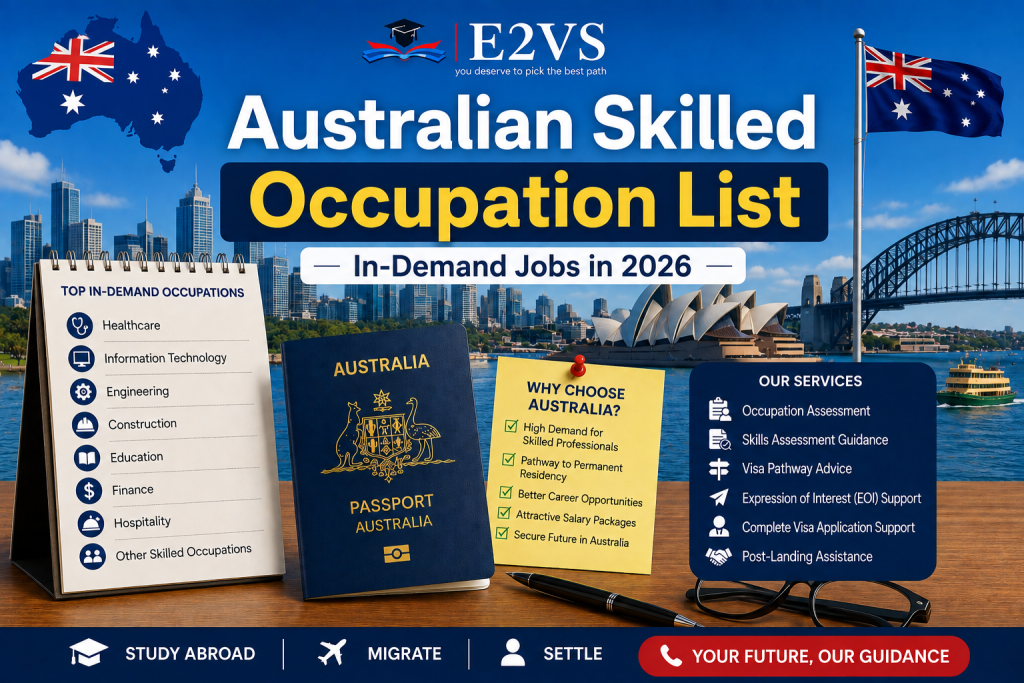
Australia remains a popular option for skilled migrants to fill gaps in the workforce in a range of industries. Skilled migration is a key pathway to address critical labour shortages in the country and is expected to continue playing a significant role in the country’s future recruitment needs, as a consequence of a steadily expanding economy, an ageing population, an expanding infrastructure and growing demands for health and technology professionals.
When considering a skilled visa to Australia, a common question that arises is, “Is my profession in demand in Australia?
The positions on Australia’s Core Skills Occupation List (CSOL) and other occupation lists are those that are required across the different skilled migration programs. The lists are used for eligibility for various employer-sponsored and skilled visa categories. An occupation list, however, does not mean that those on the list are automatically eligible for a visa, as there are a number of other requirements for visa eligibility, such as skills assessment, English language proficiency, age, health, character and any visa specific requirements.
If you are in need of professional advice, you should work with a Migration Visa Consultant in Australia to help you understand your occupation eligibility, visa requirements and viable migration pathways.
This guide will cover the most popular jobs in Australia, industries that have skill shortages, and what you need to do to follow the path of a successful migration.
What Is the Australian Skilled Occupation List?
Occupations are identified on occupation lists as having a shortage of skills in Australia. The lists are reviewed and updated regularly in accordance with the needs of the labour market.
There are a number of skilled migration pathways such as occupation lists:
- Skilled Independent Visa (Subclass 189)
- This is a skilled nominated visa (subclass 190).
- The subclass 491 visa is commonly known as the skilled visa (regional visa).
- Employer-sponsored visa programs
- State and Territory nomination programs
Every occupation has an ANZSCO (Australian and New Zealand Standard Classification of Occupations) code which might also be accompanied by a requirement for a positive skills assessment by the appropriate assessing authority.
Industries Currently Experiencing High Demand
The industries that have been experiencing a high demand are:
There are shortages of workers in several industries in Australia.
There is the highest demand at the moment for:
- Healthcare
- Information Technology
- Engineering
- Construction
- Education
- Trades
- Agriculture
- Hospitality
- Transport and Logistics
- Social and Community Services
Let’s take a closer look at these industries.
Healthcare Professionals
The healthcare industry is one of the most critical areas in Australia because of the growing aging population and the rising demands for healthcare.
Some of the most popular careers are:
Registered Nurses
Specializations may include:
- Aged Care
- Mental Health
- Critical Care
- Emergency
- Medical-Surgical
- Paediatrics
Doctors
Demand exists for:
- General Practitioners
- Medical Specialists
- Resident Medical Officers
Allied Health Professionals
Including:
- Physiotherapists
- Occupational Therapists
- Speech Pathologists
- Pharmacists
- Medical Laboratory Scientists
- Radiographers
Information Technology (IT)
The digital transformation in Australia is continuing to drive strong demand for IT professionals.
The following jobs are in high demand:
- Software Engineers
- Software Developers
- ICT Business Analysts
- Cyber Security Specialists
- Systems Analysts
- Network Engineers
- Cloud Engineers
- Data Scientists
- Database Administrators
- DevOps Engineers
Technical staffers who have exposure to cloud computing, artificial intelligence, cyber security, and software development are especially in demand.
Engineering
Engineers are integral to Australia’s infrastructure, the mining industry, renewable energy industry and manufacturing industry.
A wide variety of engineering jobs exist, such as:
- Civil Engineers
- Mechanical Engineers
- Electrical Engineers
- Structural Engineers
- Mining Engineers
- Chemical Engineers
- Environmental Engineers
- Industrial Engineers
Demand for large-scale public infrastructure and renewable energy projects remains strong.
Construction and Building Trades
Skilled construction labour continues to be a constraint in Australia.
High-demand occupations include:
- Electricians
- Carpenters
- Plumbers
- Bricklayers
- Roof Tilers
- Painters
- Welders
- Cabinet Makers
- Joiners
- Construction Managers
There are especially good job prospects in many parts of the region.
Teachers and Education Professionals
Australia has a need for qualified teachers at various levels of education.
These are some of the occupations that are in high demand:
- Early Childhood Teachers
- Secondary School Teachers
- Special Education Teachers
- Mathematics Teachers
- Science Teachers
Opportunities for teaching are particularly good in regional communities.
Hospitality and Tourism
Employment in the hospitality sector is becoming a popular career choice for many Australians, with employers looking for skilled workers.
Common occupations include:
- Chefs
- Cooks
- Restaurant Managers
- Hotel Managers
- Bakers
- Pastry Cooks
Opportunities may be available throughout Australia for qualified professionals with industry experience.
Transport and Logistics
Expand transport networks have led to the need for more transport professionals.
Occupations include:
- Truck Drivers
- Delivery Drivers
- Supply Chain Managers
- Logistics Coordinators
- Warehouse Managers
Agriculture
Skilled workers are vital to Australia’s agriculture industry.
Examples include:
- Agricultural Consultants
- Farm Managers
- Horticulturists
- Agricultural Scientists
- Livestock Farmers
Eligible applicants may have further opportunities to consider through regional migration pathways.
Social and Community Services
More people are seeking disability support and aged care services, and this has led to more jobs.
Occupations include:
- Social Workers
- Welfare Workers
- Disability Support Coordinators
- Counsellors
- Community Workers
How Do You Know If Your Occupation Is Eligible?
Just having a high demand job does not qualify someone for a good job.
Typically, applicants are required to:
- Identify their occupation on the appropriate Australian occupations list.
- Get a positive skills assessment from the relevant assessment authority.
- Meet English language requirements.
- Meet age restrictions (if applicable).
- Gain the necessary points for points-tested visas.
- Satisfy health and character standards.
Professional registration or licensing might also be needed for some occupations in Australia.
Why Skills Assessment Is Important
Applicants must undergo a skills assessment prior to submitting a visa application for most skilled visas.
Different occupations will be assessed by different authorities.
Examples include:
- Engineers Australia
- Australian Computer Society (ACS)
- Australian Nursing and Midwifery Accreditation Council (ANMAC)
- VETASSESS
- Trades Recognition Australia (TRA)
A successful skills assessment proves that your skills and work experience match Australian standards.
Regional Australia Offers Additional Opportunities
Compared with major cities, there are more labor deficits in many regional areas.
Regional migration can have the following advantages:
- Additional visa pathways
- Increased nomination opportunities
- Access to regional employer sponsorship is provided.
- Additional points that could be awarded for certain visa types
How E2VS Australia Can Help
Regional Australia is a great opportunity for many skilled migrants to settle in the long-term.
E2VS Australia can offer assistance in the following ways:
We help skilled professionals at E2VS Australia with:
- Occupation eligibility assessments
- Skills assessment guidance
- Skilled visa advice
- Employer-sponsored visa support
- State nomination guidance
- Documentation review
- Migration strategy planning
Our team of expert education and visa services Australia professionals understands the details of our clients’ qualifications, work experience, and future aspirations, and is committed to discovering the right pathway to migration for them.
Frequently Asked Questions
- Is the Skilled Occupation List updated regularly?
Yes. Occupations lists are regularly reviewed and updated by Australia to keep up to date with the demand for occupations and shortages of labour in the country.
- Does being on the Skilled Occupation List guarantee a visa?
Applicants are required to satisfy all other visa eligibility requirements for the visa being applied for, such as skills assessment, English language, health, character and, as applicable, points and nomination requirements.
- Which occupations are currently in the highest demand?
These roles are still in high demand in Australia: healthcare workers, IT specialists, engineers, teachers, construction trades and social care workers.
- Can I migrate without a job offer?
Yes, depending on the subclass of a visa. There are some skilled visa pathways that are point-tested and do not require an employer offer of employment, and some visa pathways require sponsorship by an employer.
- Do I need work experience?
Relevant work experience is required for many skilled migration pathways, although the level and type of experience depends upon the occupation and visa strand.
Final Thoughts
Australia is still accepting skilled migrants to help fill the growing labor gaps in critical sectors and bolster the nation’s expanding economy. No matter if you are a healthcare worker, an engineer, an IT specialist, a teacher, or a skilled tradesperson, it’s essential to grasp the role you play in Australia’s migration system in order to achieve a successful outcome.
Make sure your job is eligible prior to applying, take whatever skills assessment is necessary and get professional advice if you are not sure what will be the best visa pathway for you. By being properly prepared and having the right guidance from E2VS Australia, you can confidently go through the entire process of skilled migration in Australia and get nearer to your migration goals.