
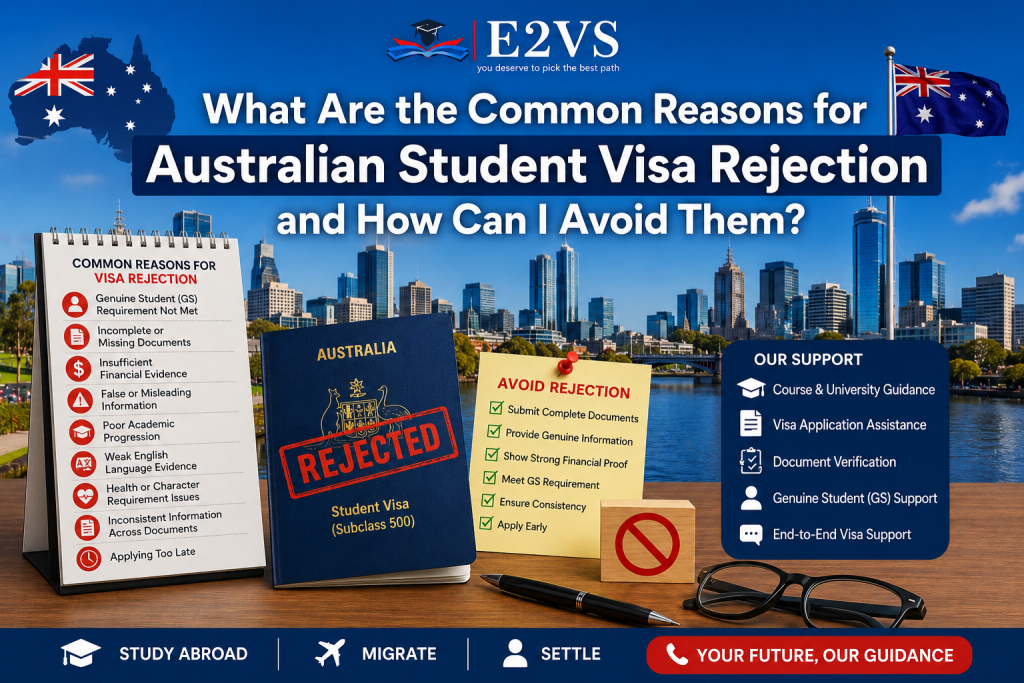
Australia continues to be one of the most sought after countries for international students to study in, not only because of its excellent learning opportunities, but also because of the career prospects and multicultural environment that it has to offer. Each year, thousands of students are granted an Australian Student Visa (Subclass 500) but far too many are delayed or denied visas simply because they made avoidable errors in their applications.
A visa refusal may impact your education goals, finances and even visa applications moving forward. Fortunately, most refusals are as a result of applicants not having enough evidence, incorrect information or do not meet the visa requirements and not because they are not eligible to study in Australia.
This guide will outline the most frequent grounds for visa refusal for Australian students and offer some tips on how to improve your visa application.
Understanding the Australian Student Visa (Subclass 500)
The Australian Student Visa is a visa granted to people who wish to study in Australia at a CRICOS-registered institution for a full-time study period. Approval, however, will be subject to demonstrating to the Australian Department of Home Affairs that you satisfy all the requirements for the visa, such as identity, financial capacity, English language (where relevant), health, character and the Genuine Student (GS) requirement.
A fully completed, accurate and honest application is required. It’s also important that students ensure their course, financial situation, previous studies and future plans are well linked. An application that is properly prepared makes it easier for the assessing authority to see the true intentions and situation of the applicant.
1. Failure to Meet the Genuine Student (GS) Requirement
A major cause of visa refusal is not meeting the Genuine Student criterion.
The Department is keen to establish your real intention in Australia is to study.
They evaluate the following:
- Your academic background
- Employment history
- Reasons for choosing Australia
- Why you selected your course
- Future career plans
- Personal circumstances
- Immigration history
How to Avoid This
- Make sure to articulate how your selected course will advance your career plans.
- Be honest about your study plans.
- Do not copy from the internet general statements.
- Be sure to keep your answers the same throughout your application.
Your GS responses need to show that you have some personal knowledge of your course and institution, your pathway to work and why you should study this course in Australia; don’t make general or broad statements.
2. Incomplete Documentation
In many cases, documents are missing from applications that lead to a delay or rejection.
Examples include:
- Missing passport pages
- Failure to receive Confirmation of Enrolment (CoE)
- Incomplete academic transcripts
- Missing financial evidence
- Missing identity documents
- No English test data available
The absence of any single document could cause delays or denial.
How to Avoid This
Make sure you have a comprehensive checklist ready when you submit your application.
- Complete
- Legible
- Correctly named
- Up to date
Students who intend to apply from India, regardless of whether they are preparing by Australian Education & Visa Experts, must make sure that their academic, financial, identity and employment histories are in sync before they send out their applications.
3. Insufficient Financial Evidence
Applicants will need to show that they have adequate financial resources to meet tuition and living expenses and travel costs if necessary.
Common problems include:
- Recent cash deposits (no money order)
- Fake bank statements
- Inconsistent financial records
- Sponsor income that is not substantiated
- Unsupported education loans
How to Avoid This
Give true financial records including:
- Bank statements
- The sanction letters for the education loan.
- Scholarship documentsGenuine Student Requirement
- Income tax returns
- Salary slips
- Sponsor income proof
Be sure to have all financial data correct and in sync. If large and/or unusual transactions are involved, it is important that there be sufficient documentation to establish the source of the funds.
4. Providing False or Misleading Information
One of the biggest errors that an applicant can make is to submit false paperwork or false information.
Examples include:
- Fake academic certificates
- Altered bank statements
- False employment records
- Incorrect work history
- Misrepresented English scores
U.S. immigration authorities thoroughly check documents submitted.
How to Avoid This
Always use any original documents.
Don’t submit inaccurate information if you aren’t sure whether a document is acceptable, ask professional advice instead. Applicants need never take it for granted that a minor change or omission will not be noticed.
5. Poor Academic Progression
When an application for a course does not relate to the applicant’s previous education and/or career experience in a logical way, the Department may ask for the applicants’ response.
Examples include:
- Pursuing a lower qualification following a higher qualification
- Choosing a course for which there is no rationale provided.
- Regular changes of subject
How to Avoid This
Clearly explain:
- Student’s response to why they chose the course.
- The impact it can have on your future career.
- Australia is the ideal place to study
A well-structured academic profile enhances your application. Provide an explanation and supporting information in a clear manner if you are changing your career and your selected course is the means to this end.
6. Weak English Language Evidence
A few applicants do not meet the English language requirements or do not provide up-to-date test results.
Accepted English language tests include:
- IELTS
- PTE Academic
- Both TOEFL iBT (when required) and IELTS are accepted.
- Cambridge English
How to Avoid This
- Prepare your English test well in advance of the application.
- Make sure that your scores are met for university and visa requirements.
- Ensure that your results still hold true when you submit your application.
See current requirement for applicants depending on their circumstances; requirements may differ according to the visa and education provider.
7. Health Requirement Issues
In Australia, a significant number of student visa holders are needed to get medical exams.
Applications will be delayed if:
- Medical examinations are inadequate
- Further health data is sought.
- Applicants do not show up for appointments
How to Avoid This
Have a medical examination by an approved panel physician promptly and follow-up any further requests promptly. To prevent unnecessary delays, it is important to keep an appointment record and reply within the designated time.
8. Character Requirement Concerns
Applicants are required to meet Australia’s character requirements.
The following factors can cause problems:
- Criminal convictions
- If you don’t disclose previous offences it could cause issues later on.
- Failure to have police clearance certificates.
How to Avoid This
Be truthful in revealing information and submit any character documents when asked.
If you try to cover up past problems you run the risk of rejection. In complex situations, it can be helpful to seek legal advice before submitting the application so that you have an understanding of what is required to be disclosed.
9. Inconsistent Information Across Documents
Assessment can raise concerns at any size of discrepancy.
Examples include:
- Names can be different spellings.
- Mistakes in the date of birth information.
- Conflicting employment dates
- Table 50% contrast mode—Outlines the changes to financial figures for documents.
How to Avoid This
Carefully read all documents prior to submission.
Make sure all information is consistent across:
- Passport
- Academic records
- Financial documents
- Visa application
- Employment records
This is especially crucial where the application is drafted using migration consultants Melbourne providing these services, as all documents submitted to the consultant must have correct and consistent information.
10. Applying Too Late
There are students who wait until toward the end to apply for courses.
Late applications can lead to the risk of:
- Missing document deadlines
- Delayed medical examinations
- Not enough time to respond to requests for further information
How to Avoid This
Start your application several months in advance of your intended enrollment.
Proper preparation lessens stress and provides opportunity to address problems. It also provides students with more time to get financial documents organized, take English tests, schedule health checks and prepare GS responses.
Additional Tips to Improve Your Chances of Visa Approval
The top tips for a successful student visa application include:
- A valid passport
- Genuine academic documents
- Confirmation of Enrolment (CoE)
- Clear financial evidence
- Valid Overseas Student Health Cover (OSHC)
- Excellent Genuine Student responses
- Correct English language outcomes
- The same info on each page of the application
Ears to see the detail can make all the difference. Review all forms, statements and supporting documents once more prior to lodging.
How E2VS Australia Can Help
There’s a lot more to the process of applying for an Australian student visa than filling in online forms.
We help students through the application process here at E2VS Australia by offering them the following:
- Course selection
- University admissions
- Student visa guidance
- Document verification
- Genuine Student preparation
- Before submitting, the application will be reviewed, and a revision will be provided if necessary.
- Support in devising a response to Department requests
Our qualified staff members collaborate closely with students to reduce errors and high-quality applications. Applicants can seek advice from a professional to help prepare for the visa; however, no consultant can ensure that applicants will be approved for the visa as this is a decision made by the Australian Department of Home Affairs.
Frequently Asked Questions
Is it possible to apply for a student visa to Australia if the visa is refused?
Yes. Depending on the refusal, it might be possible to re-apply after corrections to the issues raised by the Department of Home Affairs.
Does failure to make a single error always lead to visa denial?
Not necessarily. While processing, minor problems can be resolved but large deficiencies or lack of the required visa requirements can lead to refusal of the visa.
Does previous visa rejection impact on future applications?
It can. Refusals, if any, made in previous applications must be recorded, and reasons for refusal (if any) in previous applications must be given in future applications.
Does an education consultant help to decrease the likelihood of rejection?
Having a qualified education and migration consultancy service review your paperwork, they can advise you on any possible problems and make sure you have all your paperwork in order before you submit your application. But it’s important to remember that no consultant is able to guarantee that your visa will be granted, it is a decision made by the Australian Department of Home Affairs.