
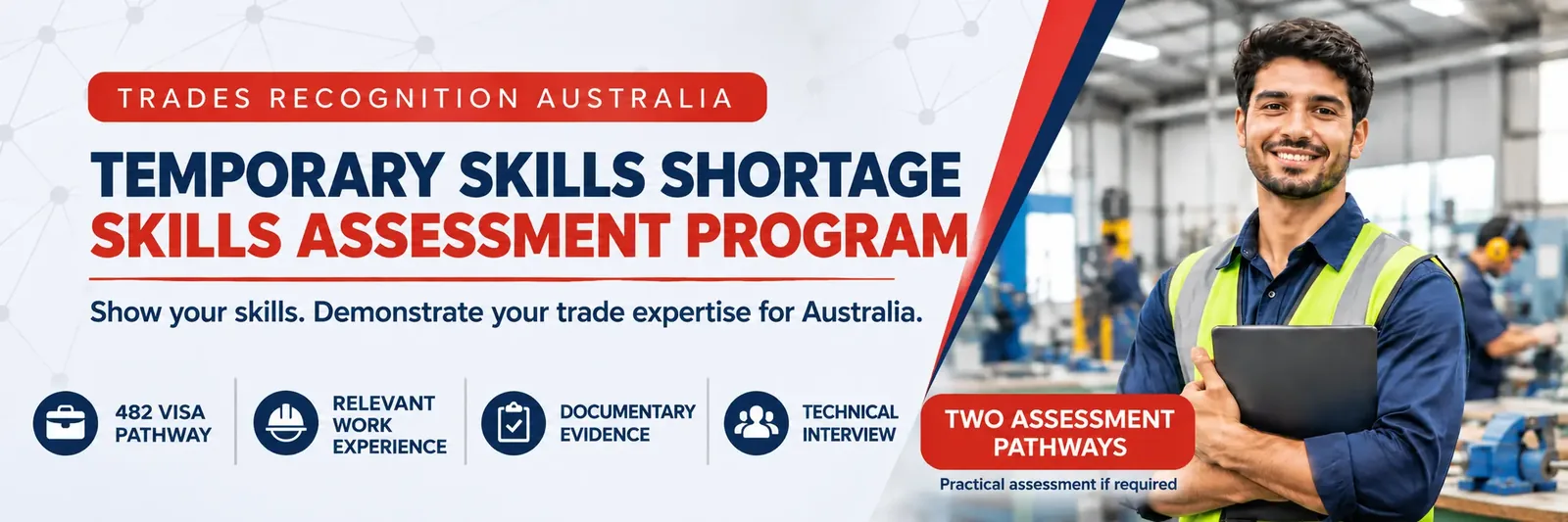
TSS Skills Assessment for the 482 Skills in Demand Visa
If your Australian employer is sponsoring you on a Subclass 482 visa and you work in a trade, there's a good chance you'll need a TSS skills assessment before the visa can be granted. It's run through Trades Recognition Australia (TRA), carried out by an approved training provider, and it's compulsory for electricians.
This guide explains who needs the TSS Skills Assessment Program, the two pathways, the latest TRA fees, the 9-week processing time and each step from choosing an RTO to getting your outcome. It also covers how E2VS, with our registered migration agent, helps you get it right the first time.
TSS in 30 Seconds: A TSS skills assessment is TRA's check that you can work at the skill level Australia expects for your nominated occupation. It's for Skills in Demand (subclass 482) visa applicants from listed countries in listed trades. It costs up to $5,320 (Pathway 1) or $2,020 (Pathway 2) and takes about 9 weeks.
- Up to $5,320 (Pathway 1)
- $2,020 (Pathway 2)
- ≈9 weeks processing
What Is the TSS Skills Assessment Program?
The Temporary Skills Shortage Skills Assessment Program is one of TRA's migration skills assessments. It tests one thing: can you actually do the job in your nominated occupation at the standard an Australian workplace expects?
You don't deal with TRA directly at the start. An approved Registered Training Organisation (RTO) reviews your evidence, interviews you and, where needed, watches you work in a practical test. The RTO then recommends an outcome, and TRA makes the final decision.
A positive result gives Home Affairs the independent proof of skill it needs for your visa. A negative result usually means a refused or delayed visa, which is why preparation matters so much.
TSS Visa Is Now the Skills in Demand Visa (Subclass 482)
On 7 December 2024, the Temporary Skill Shortage (TSS) visa subclass 482 was replaced by the Skills in Demand visa. The subclass number stayed the same, which is why people still search for the "TSS 482 visa" and why TRA's program kept its TSS name.
The Skills in Demand (SID) visa has three streams: Core Skills, Specialist Skills and Labour Agreement. Most tradespeople fall under the Core Skills stream, which uses the Core Skills Occupation List. If your occupation needs a mandatory skills assessment for that stream, the TSS skills assessment is how trade applicants from listed countries meet it.
Who Needs a TSS Skills Assessment for the 482 Visa?
You'll need a skills assessment for the 482 visa through this program if all four of these apply to you:
Your nominated occupation is on the TSS Program Occupation List. This is TRA's own list of trades covered by the program. It isn't the same as the Home Affairs Core Skills Occupation List.
You hold a current passport from a listed country or Special Administrative Region (SAR). TRA keeps a separate TSS Program Country List.
You have relevant work experience in your nominated occupation.
Home Affairs has asked for a discretionary skills assessment. The department can request one where it needs extra proof of your skills.
Missing one of these usually means a different TRA program, or no TRA assessment at all.
TSS Skills Assessment for Electricians (Licensed Occupations)
For two licensed occupations, the TSS skills assessment isn't optional. If you're applying for a Subclass 482 visa as one of these, you must complete it:
- Electrician (General)
- Electrician (Special Class)
Electrical work is tightly regulated in Australia, so this electrician skills assessment sets a high bar. Expect a detailed look at your wiring, testing and safety experience, and possibly a practical test at an approved venue. Electricians who come prepared, with clear payslips, references and work photos, tend to move through each step much faster.

TSS Skills Assessment Eligibility Requirements
Before you pay anything, make sure you can tick every box below. TRA's RTOs will check these again during your application.
If your work history has gaps, or you're unsure whether your duties match your nominated occupation, sort that out now. It's far cheaper than failing the documentary evidence step.
- You're employed, or were recently employed, in your nominated occupation, and you can prove it with documents such as payslips, contracts, tax records or employer references.
- You're from a nominated country or SAR on the TSS Program Country List.
- You have a current passport.
- You can travel to an approved assessment venue if your RTO needs you to sit a practical assessment.
TSS Skills Assessment Pathways: Pathway 1 vs Pathway 2
The program has two pathways. Which one you take depends on whether you already hold an Australian qualification or licence.
Pathway 1
- Who it's for
- Applicants without a relevant Australian Vocational Education and Training (VET) qualification
- Steps
- Documentary evidence, technical interview, practical assessment (if required)
- Total TRA fee
- Up to $5,320
Pathway 2
- Who it's for
- Applicants with a relevant Australian VET qualification, or a current identified Australian occupation licence with no restrictions
- Steps
- Documentary evidence, technical interview
- Total TRA fee
- $2,020
Most overseas tradespeople take Pathway 1. If you studied or got licensed in Australia before, check Pathway 2 first, because it's cheaper and shorter.
How Much Does a TSS Skills Assessment Cost?
Here’s exactly what each step of the TSS skills assessment costs, based on TRA’s current fees.
Pathway 1
| Assessment step | Fee (AUD) |
|---|---|
| Documentary evidence | $1,120 |
| Technical interview | $2,000 |
| Practical assessment (if required) | $2,200 |
| Total | $5,320 |
Pathway 2
| Assessment step | Fee (AUD) |
|---|---|
| Documentary evidence | $1,120 |
| Technical interview | $900 |
| Total | $2,020 |
These fees cover the skills assessment only. Your 482 visa fees, your employer's nomination costs and any professional help are separate.
≈9 weeks processing
TSS Skills Assessment Processing Time
TRA typically processes TSS skills assessment applications within 9 weeks, and as of July 2026 the average was tracking at exactly 9 weeks. Your actual timeframe depends on how quickly you complete each step.
Two details matter here.
- The 9-week TSS processing time only begins once you’ve submitted all your documentary evidence, not when you first contact your RTO.
- You must finish each assessment step before the next one opens. A late reference letter or a missed interview slot delays everything after it.
- Processing times are a guide only. Some applications take longer, so build some buffer into your 482 Skills in Demand visa processing time and your employer's start date.
One missing document can cost you weeks.
Our registered migration agent checks your evidence, confirms your pathway and makes sure your skills assessment for the 482 visa lines up with your nomination before you pay a single TRA fee. Meet us in Melbourne CBD or online.
How to Apply for the TSS Skills Assessment: Step by Step
Step 1: Confirm you actually need it.
Check with Home Affairs that your visa pathway needs a skills assessment, and make sure TRA is the right assessing authority for your occupation. TRA's Pathfinder tool helps you confirm the TSS program is the right fit. Our registered migration agent can check this against your nomination for you.
Step 2: Read the TSS Program Guidelines.
They set out the evidence rules, extra fees, reviews and refunds. Ten minutes here can save you a failed step. E2VS can walk you through the parts that apply to your trade.
Step 3: Choose an approved RTO.
Use TRA's RTO Finder to search your nominated occupation and pick an RTO that assesses it. Our registered migration agent can explain what to ask before you commit.
Step 4: Contact the RTO and get your Payment Identifier Code.
The RTO checks your eligibility, tells you exactly what evidence to provide and issues a Payment Identifier Code for the first step. You pay that step through TRA's Online Portal.
Step 5: Submit your documentary evidence.
Upload your employment proof, references, qualifications and passport. This is where most delays start, so E2VS and our registered migration agent review your file before it goes in.
Step 6: Complete the technical interview.
An assessor asks you about your day-to-day work, tools and safety practices. Talk about real jobs you've done. Generic answers tend to score poorly.
Step 7: Sit the practical assessment (Pathway 1, if required).
If your RTO asks for one, you'll show your skills at an approved venue. Electricians should expect this to be thorough.
Step 8: Receive your outcome.
The RTO recommends an outcome, TRA approves it, and your RTO emails you the result. Our registered migration agent then helps you use it in your 482 visa application.
Send us an enquiry
Not sure you need a TSS skills assessment? Let's find out in one session.
Documents You'll Need for a TSS Skills Assessment
Your TRA-approved RTO will confirm the exact list, but most TSS skills assessment applicants need these documents:
- A current, valid passport, including the photo and details page
- Proof of paid employment: payslips, contracts, tax or bank records
- Detailed employer references showing your duties, dates and hours
- Qualifications, licences and transcripts, with certified English translations
- An up-to-date CV covering your work history in your nominated occupation
- Photos or videos of your work on the job, if your RTO accepts them
Make sure the duties on your references match your nominated occupation. A mismatch here is one of the most common reasons a TSS skills assessment stalls.
Common Reasons a TSS Skills Assessment Is Unsuccessful
Weak employment evidence. References without dates, hours or duties don’t prove your skills to TRA. Clear payslips and detailed employer letters make your TSS assessment much stronger.
Wrong nominated occupation. If your evidence points to a different trade, your assessment can fail. Make sure your duties match your nominated occupation before you apply.
Generic interview answers. TRA assessors want real examples from your own jobs, not textbook answers. Talk through actual tasks, tools and safety steps in your technical interview.
Not ready for the practical test. The practical assessment checks safe, current work practice. Electricians in particular should prepare thoroughly for this part of the TSS skills assessment.
Skipping the TSS guidelines. Missing a rule in the TRA guidelines can mean extra fees or a step you can’t progress past. Read them carefully, or have our registered migration agent check for you.
TSS vs OSAP vs MSA: Which TRA Skills Assessment Do You Need?
TRA offers several skills assessment programs, and the right one depends on your visa, your country and your qualifications. Choosing the wrong one costs you time and fees, so compare TSS, OSAP and MSA here.
| Program | Main visa purpose | Typical use |
|---|---|---|
| TSS Skills Assessment | Skills in Demand visa subclass 482 | Tradespeople from listed countries being sponsored by an Australian employer. Compulsory for electricians |
| Offshore Skills Assessment Program (OSAP) | Permanent and provisional skilled visas, such as 189, 190 and 491 | Overseas tradespeople from listed countries in listed trades, assessed through documents, an interview and a practical test |
| Migration Skills Assessment (MSA) | Permanent and provisional skilled visas, such as 189, 190 and 491 | Qualified tradespeople with a formal qualification and work experience, assessed on documents only |
Not sure which one fits? Our registered migration agent can tell you in one consultation.
How E2VS Helps With Your TSS Skills Assessment
At E2VS, we look at your whole pathway, not just the TSS skills assessment in front of you. Our Melbourne team, led by registered migration agent Gaurav Chawla (MARN 1806582), brings over 10 years of experience helping tradespeople and employers through TRA assessments and the 482 Skills in Demand visa. We help you:
- Confirm whether your 482 visa needs a TSS skills assessment, and which pathway fits you
- Choose the right TRA-approved RTO and understand each assessment payment step
- Prepare employment evidence and references that clearly match your nominated occupation
- Get fully prepared for your TRA technical interview and practical skills assessment
- Align your TSS outcome with your employer’s nomination and your Skills in Demand visa application
- 3,000+Students assisted since 2016
- 99%Visa granted
- 10+Years of experience
Related TRA Skills Assessments
- TRA Skills AssessmentAll six TRA skills assessment programs explained in one guideView page
- Offshore Skills Assessment Program (OSAP)TRA skills assessment for overseas tradespeople in listed countriesView page
- Migration Skills Assessment (MSA)Documents-only TRA assessment for qualified, experienced tradespeopleView page
- Job Ready ProgramTRA pathway for PSA holders moving to Australian permanent residencyView page
- Provisional Skills Assessment (PSA)TRA skills assessment for trade graduates applying for the 485 visaView page
- Employer Sponsored Visa 482 Skills in Demand, 186 and 494 employer sponsored visa optionsView page
TSS Skills Assessment FAQs
Get Your TSS Skills Assessment Right the First Time
A TSS skills assessment can make or break your 482 Skills in Demand visa. The rules are clear once you know them: check that you're eligible, choose the right pathway, prepare strong evidence and finish each step on time. Getting it wrong costs weeks, and sometimes thousands of dollars in repeat fees.
Talk to E2VS before you contact an RTO. Our registered migration agent will confirm whether you need the assessment, help you choose the right pathway and check your documents, so you lodge with confidence.
Melbourne CBD or online · AUD $100 consultation with our registered migration agent